Core Temp CPU Monitor
Core Temp is a free, lightweight Windows tool that shows the real temperature of every CPU core, live load and clock speed, and can protect your PC from overheating. Get the verified Core Temp download for Windows 11 and 10 below.
 Developed by Arthur Liberman (ALCPU) · Latest version 1.21
- 1.21Latest version
- October 3, 2026Release date
- FreewareLicense
- Intel · AMD · VIAProcessors
- ALCPUDeveloper
What Is Core Temp?
Core Temp is a compact Windows program that monitors processor temperature and other vital CPU information in real time.
Core Temp reads the digital thermal sensor (DTS) built into each core of modern Intel, AMD and VIA x86 processors. Alongside temperature it shows load, clock speed, voltage ID, platform and Tj. Max, the limit at which the chip starts to throttle. Settings add taskbar icons, CSV logging and an overheat protection action.
Its Purpose
To answer one question quickly and reliably: is the CPU running too hot? It does this without the weight of a full hardware suite.
Who Should Use Core Temp
Anyone who wants to keep an eye on CPU heat: gamers, laptop owners, PC builders, developers running long builds and technicians checking customer machines.
Recent Core Temp Releases
- Oct 2026 · 1.21 redesigns tray settings and hardens the legacy driver
- May 2026 · 1.20.1 fixes Ryzen readings after sleep
- Apr 2026 · 1.20 improves AMD APU detection
- 2025 · 1.19.5 adds per-CCD Zen readings and P-core/E-core labels
Developed by Arthur Liberman (ALCPU). Full changelog on the download page.
Key Features
What Core Temp does, feature by feature.
Per-Core Temperatures
See the live temperature of every core, not just an average, so you spot a hot core the moment it appears.
Accurate Sensor Readings
Readings come straight from each core's digital thermal sensor, so no extra hardware is needed.
Min, Max & Load Tracking
Peak and lowest values are recorded automatically, so after any game or render you know exactly how hot it got.
Overheat Protection
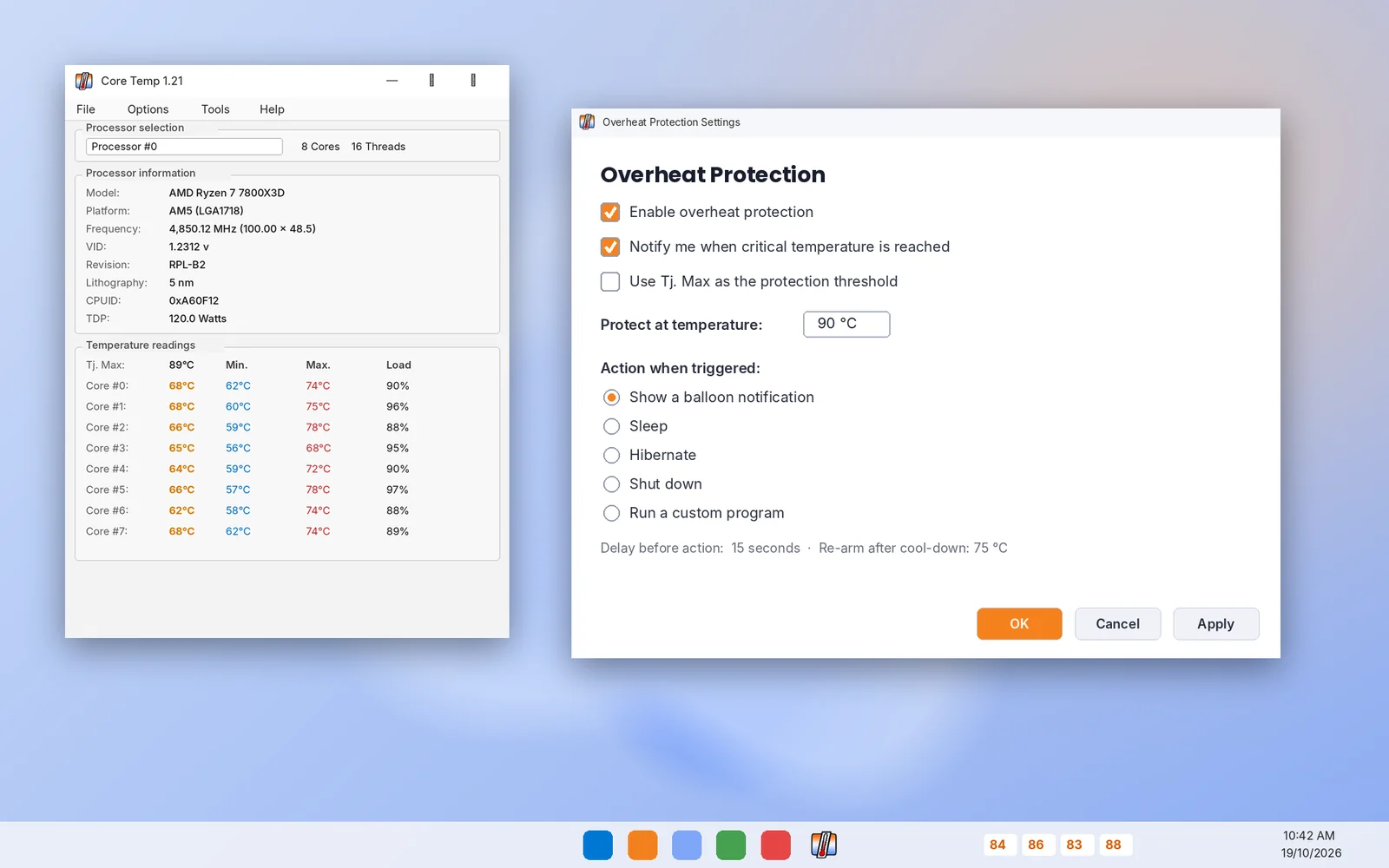
Set a limit and Core Temp can warn you, sleep, hibernate or shut down the PC before heat causes damage.
Taskbar Temperature Icons
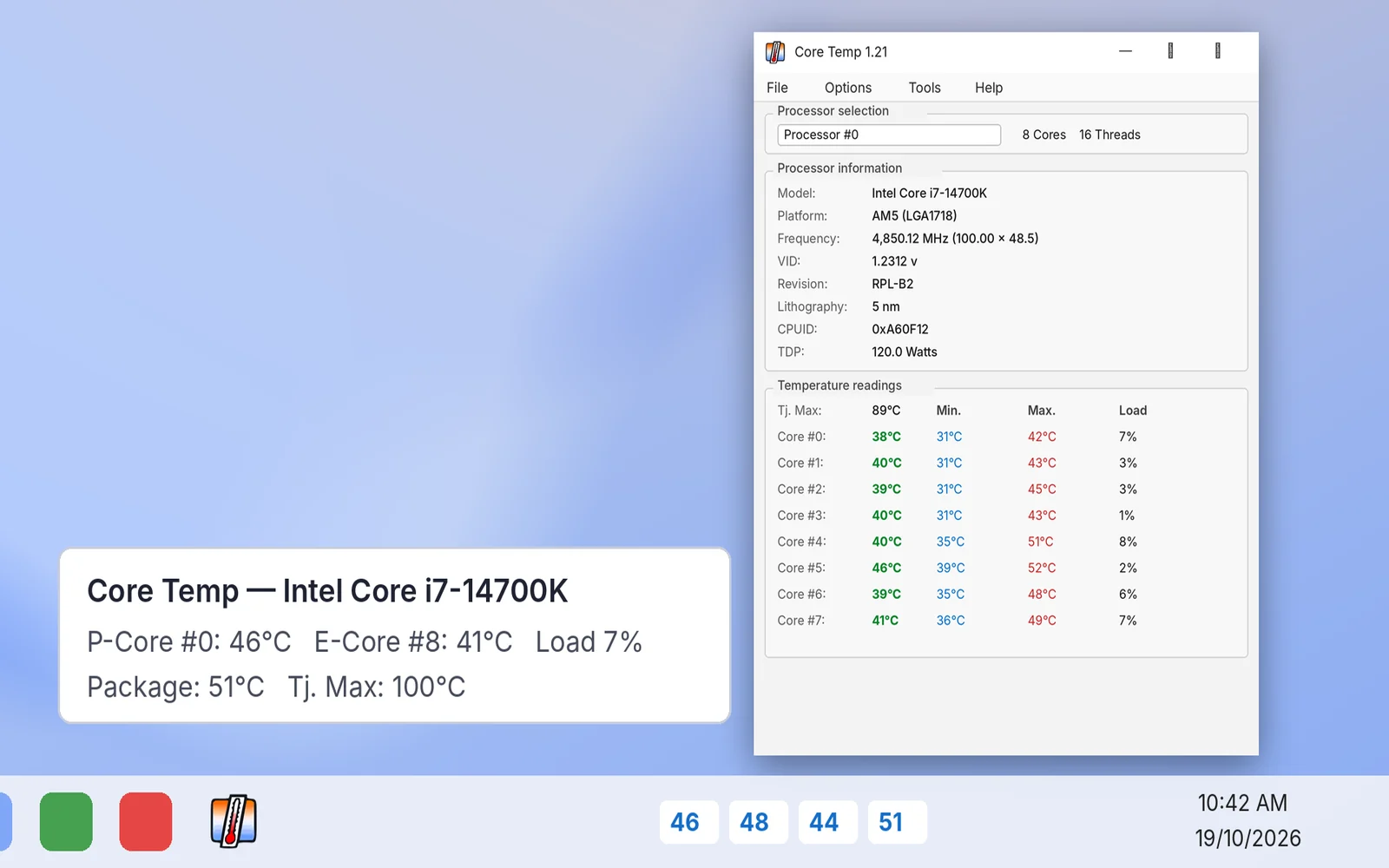
Keep temperatures visible in the Windows notification area without opening a window or interrupting your work.
CSV Logging
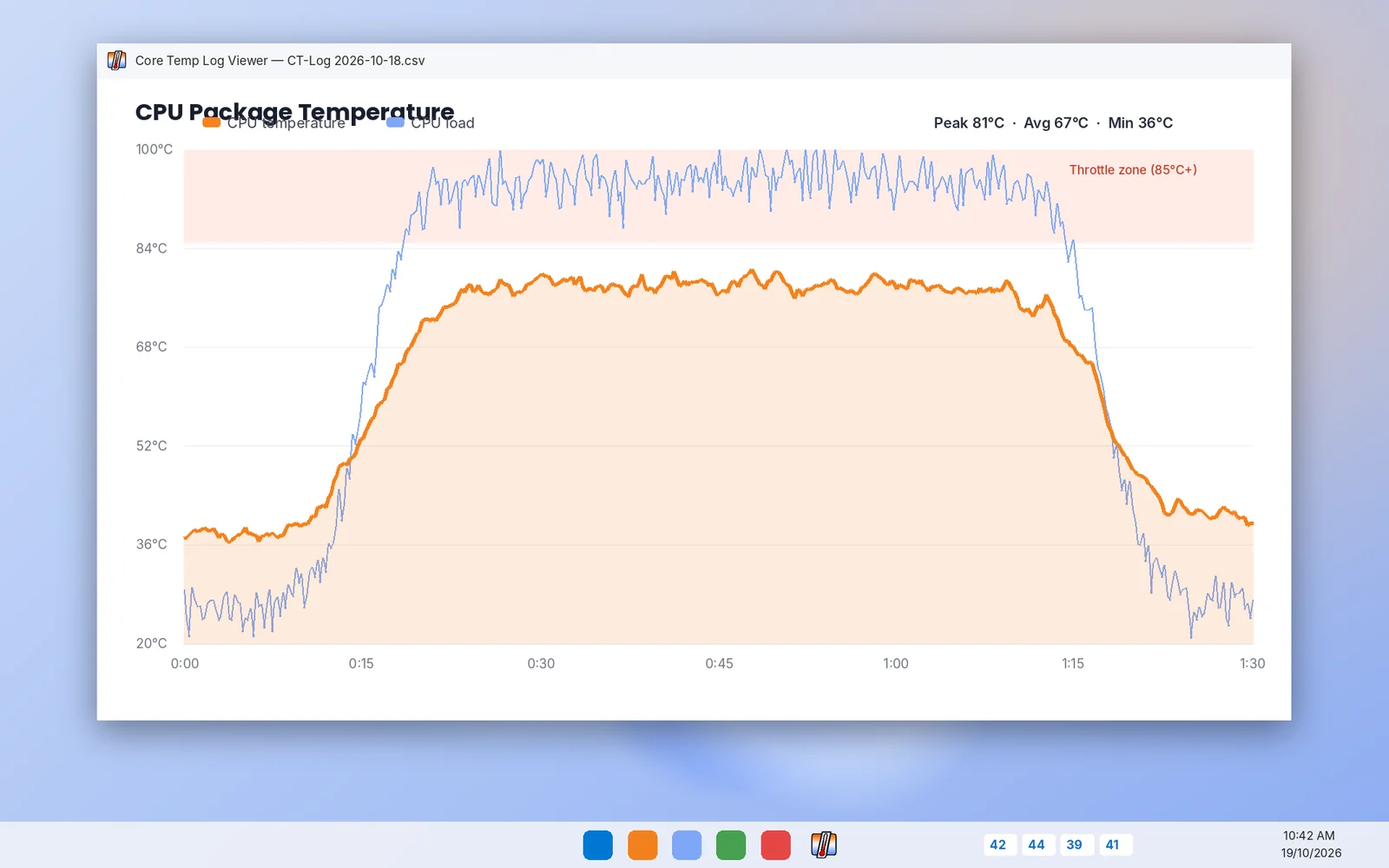
Record temperature, load and frequency at your chosen interval and chart entire sessions in any spreadsheet.
Small, Efficient Footprint
A compact program with low background usage, so it can run all day alongside games and work.
Plugins & Shared Memory
Extend Core Temp with plugins, or feed its readings to widgets, overlays and your own scripts through shared memory.
Modern Intel & AMD Support
Recognises hybrid P-core/E-core Intel chips and per-CCD readings on AMD Zen, with fixes arriving in regular updates.
System Requirements
Core Temp is very light. The developer does not publish minimum RAM or storage figures; these are the real requirements.
- Operating system
- Windows 11, 10, 8/8.1, 7 and XP; Windows Server 2003–2025As listed by the developer. The winget package targets Windows 10 and later.
- Processor
- Intel, AMD or VIA x86 CPU with a digital thermal sensorBrand-new models may need the latest Core Temp release for full support.
- Permissions
- Administrator rightsNeeded to load the sensor driver.
- Graphics
- Not requiredCore Temp reads the CPU only.
- Internet
- Only to downloadCore Temp runs fully offline.
Core Temp Download
Download the official installer from the developer, then check its SHA-256 hash against the public record on GitHub.
Core Temp 1.21
Free CPU temperature monitor for Windows
| Latest version | 1.21 (build 207) |
|---|---|
| Release date | October 3, 2026 |
| Developer | Arthur Liberman (ALCPU) |
| License | Freeware (donations welcome) |
| Operating systems | Windows 11, 10, 8.1, 7, Server |
| File name | Core-Temp-setup-v1.21.0.207.exe |
| Security verification | SHA-256 published on GitHub |
SHA-256 hash
Install with winget
Winget checks the SHA-256 hash for you automatically.
How to Install Core Temp
Core Temp is a Windows program. Choose your platform; for other systems we explain the closest supported option.
Install on Windows 11 / 10
The full process takes about two minutes.
- Open the download page and select Download Core Temp to save the official
Core-Temp-setup-v1.21.0.207.exeinstaller. - Verify the file: in PowerShell run
Get-FileHash .\Core-Temp-setup-v1.21.0.207.exeand compare it with the SHA-256 published on GitHub. - Double-click the installer and approve the User Account Control prompt.
- Choose your language and install folder. Read each screen and untick any optional third-party offers.
- Finish setup and launch Core Temp from the Start menu. Temperatures appear instantly.
- Optional: open Options › Settings to enable tray icons, logging and "Start Core Temp with Windows".
Prefer the command line? Run winget install --id ALCPU.CoreTemp -e and winget handles the download, hash check and install.
Core Temp on macOS
There is no native macOS version of Core Temp.
- On an Intel Mac running Windows through Boot Camp, boot into Windows and follow the Windows steps; Core Temp then reads the CPU directly.
- Virtual machines (Parallels, VMware) usually cannot expose real CPU sensors, so Core Temp will not show temperatures there.
- For macOS itself, use a Mac-native sensor utility. See our alternatives section for guidance.
Avoid downloads claiming to be "Core Temp for Mac". The developer does not publish one.
Core Temp on Linux
Core Temp is Windows-only, but Linux has excellent built-in sensor support.
- Install the sensor tools:
sudo apt install lm-sensors(Debian/Ubuntu) or your distribution's equivalent. - Run
sudo sensors-detectand accept the defaults. - Type
sensorsto print per-core temperatures, orwatch -n1 sensorsfor a live view. - Running Core Temp through Wine is not recommended: its kernel driver cannot load, so no readings appear.
Monitor From Android
Android cannot run Core Temp itself, but you can watch your PC's readings remotely.
- Install Core Temp on your Windows PC first.
- Add the Core Temp Remote Server plugin from the developer's add-ons page and enable it in Core Temp's Plugins menu.
- Install the developer's companion app, Core Temp Monitor, from Google Play.
- Connect the app to your PC's IP address on the same network to see live temperatures and load.
Monitor From iPhone or iPad
There is no official Core Temp app for iOS at the time of writing.
- Run Core Temp on your Windows PC and enable logging to a shared folder (for example OneDrive).
- Open the CSV log in the Files or Numbers app on your iPhone to review temperatures.
- Alternatively, use a remote-desktop app to view the Core Temp window directly.
- Check the developer's official site for any new mobile clients.
Everyday Use and Settings
Start with the basics, then turn on the settings that make Core Temp useful every day.
Getting Started
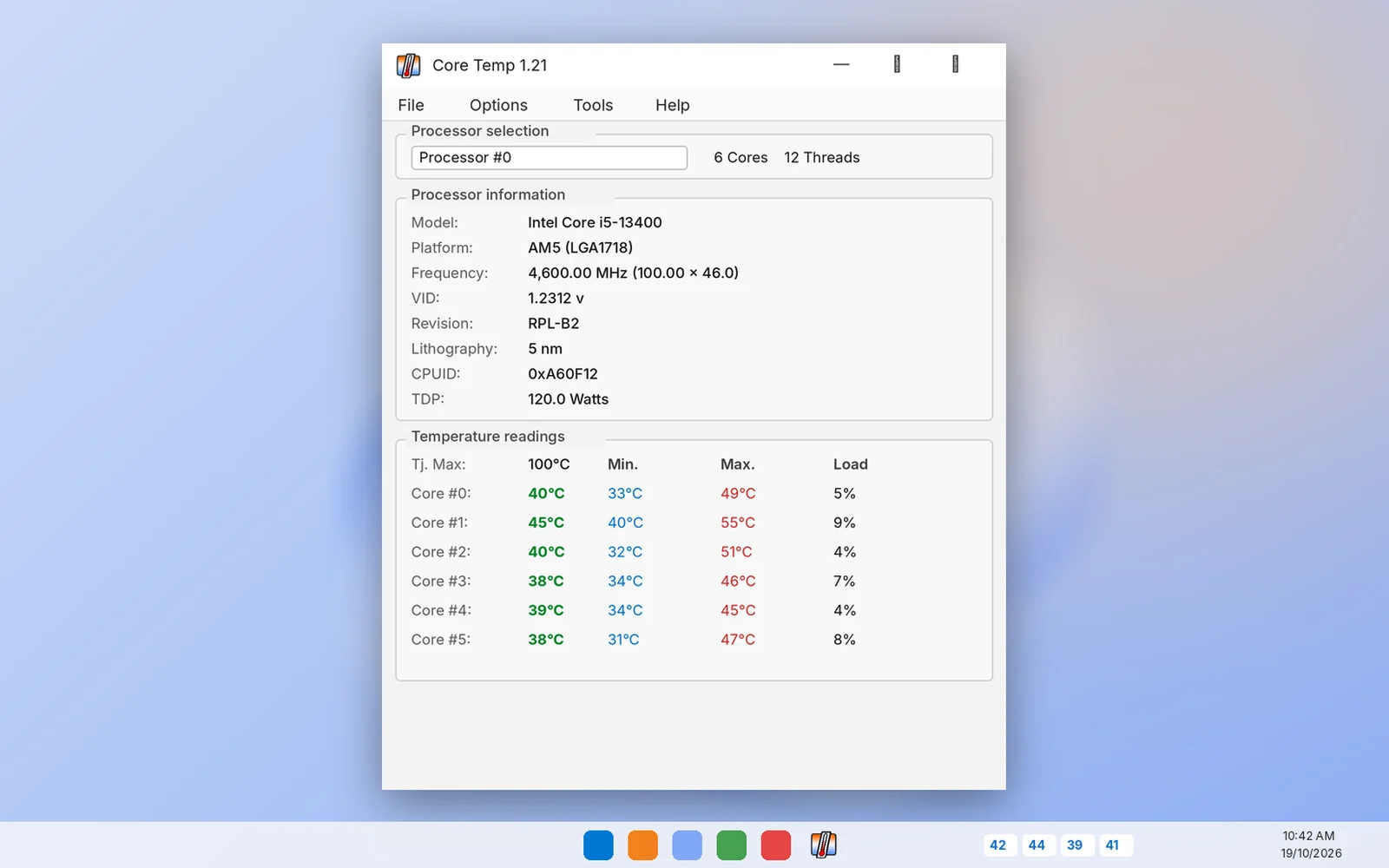
- Find your cores under Temperature Readings.
- Watch the colours: green is cool, amber warm, red hot.
- Check Max after a game to see your peak.
- Hover the tray icon for a quick summary.
Useful Settings
- Logging: record readings to a CSV file.
- Distance to Tj. Max: show headroom instead of degrees.
- Overheat protection: notify, sleep or shut down at a limit.
- Plugins: add remote monitoring and more.
Best Practices
- Reopen Core Temp to reset Min/Max before a test.
- Compare readings at similar room temperatures.
- Update Core Temp when you change CPU.
- Log before and after cleaning or repasting.
Every setting is explained step by step in the Core Temp user guide.
How Core Temp Works
What happens every second while Core Temp runs, from the processor sensor to the number in your taskbar.
Sensor Reading
Each core's digital thermal sensor measures its own junction temperature.
Driver Access
A small driver reads the processor registers that normal apps cannot reach.
Value Conversion
Raw sensor offsets are converted with Tj. Max into real degrees per core.
Live Display
The window, tray icons and Min/Max values refresh at your chosen interval.
Protection
Logs are written and, if a limit is crossed, your chosen action runs.
Core Temp Compatibility at a Glance
Where Core Temp runs and what it works with, in one quick reference.
- Operating systems
- Windows 11, 10, 8/8.1, 7 and Windows Server32-bit and 64-bit editions, with standalone 32-bit and 64-bit builds. No macOS or Linux version.
- Processors
- Intel, AMD and VIA x86 CPUsIncludes hybrid P-core/E-core Intel and AMD Ryzen. Windows on ARM is not supported.
- Devices
- Desktops, laptops, mini PCs and serversAny x86 Windows machine with administrator access.
- Runtime
- None requiredNative Windows app; no .NET or Java runtime to install.
- Integrations
- Plugins and shared memoryRemote monitoring, the Android companion app, widgets and overlays.
- Package manager
- winget
winget install --id ALCPU.CoreTemp -e
Pros and Cons
Where Core Temp excels, and where you may want an additional tool.
Strengths
- Per-core temperatures read directly from the CPU
- Small, light program with low background usage
- Per-core taskbar icons keep readings visible
- Built-in overheat protection actions
- Free, with standalone builds and regular updates
Limitations
- CPU only: no GPU, fan or drive sensors
- Installer may show optional third-party offers
- No built-in graphs; charts need a plugin or spreadsheet
- Windows only; no macOS or Linux version
- Brand-new CPUs may need an update for full support
Who Uses Core Temp?
From students to IT teams, here is how different people put Core Temp to work.
Students
Keep an ageing laptop healthy through long study sessions.
- Spot clogged fans before a shutdown
- Run it portable on shared lab PCs
Gamers
Catch heat build-up before it costs frames.
- Log full gaming sessions
- Keep the hottest core in the taskbar
Developers
Keep long builds and benchmarks stable.
- Watch per-core heat during compiles
- Read readings from scripts via shared memory
Business Users
Protect office and workstation fleets at no cost.
- Deploy silently with winget
- Use overheat protection on unattended PCs
Researchers
Collect reliable thermal data on long runs.
- Log multi-day simulations
- Correlate throttling with performance dips
Content Creators
Render and stream without thermal surprises.
- Monitor all-core loads during exports
- Spot throttling that slows renders
Screenshots
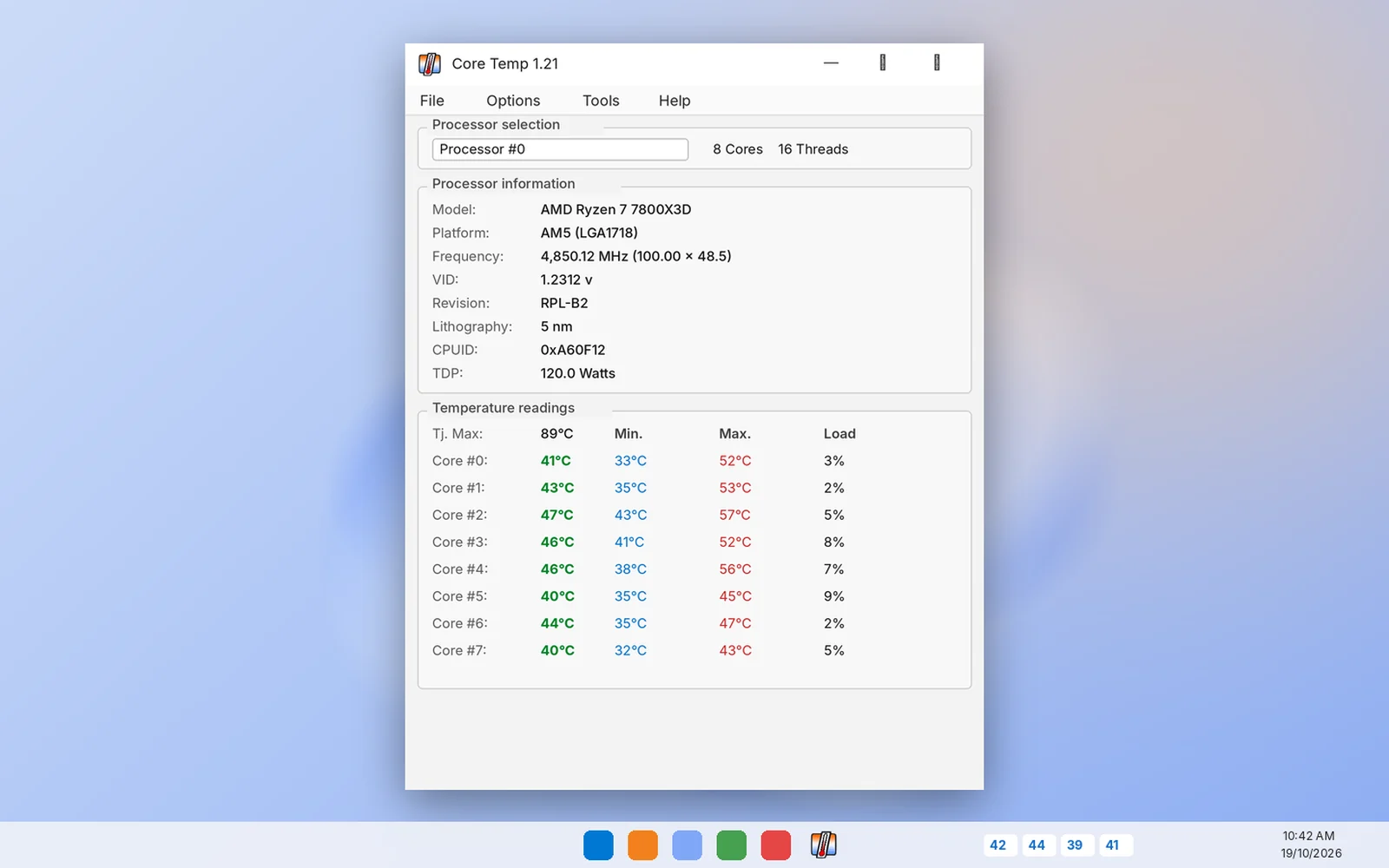
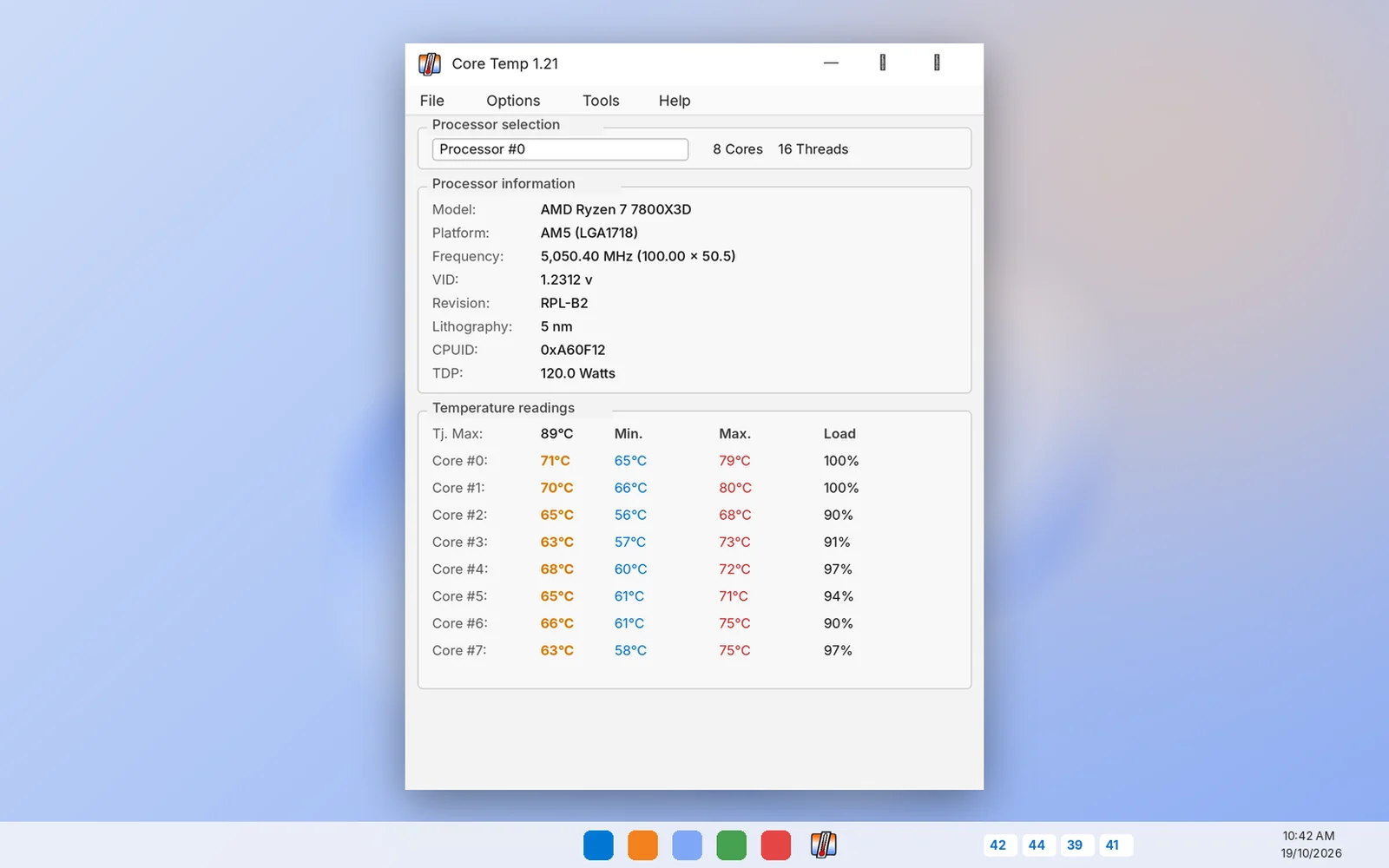
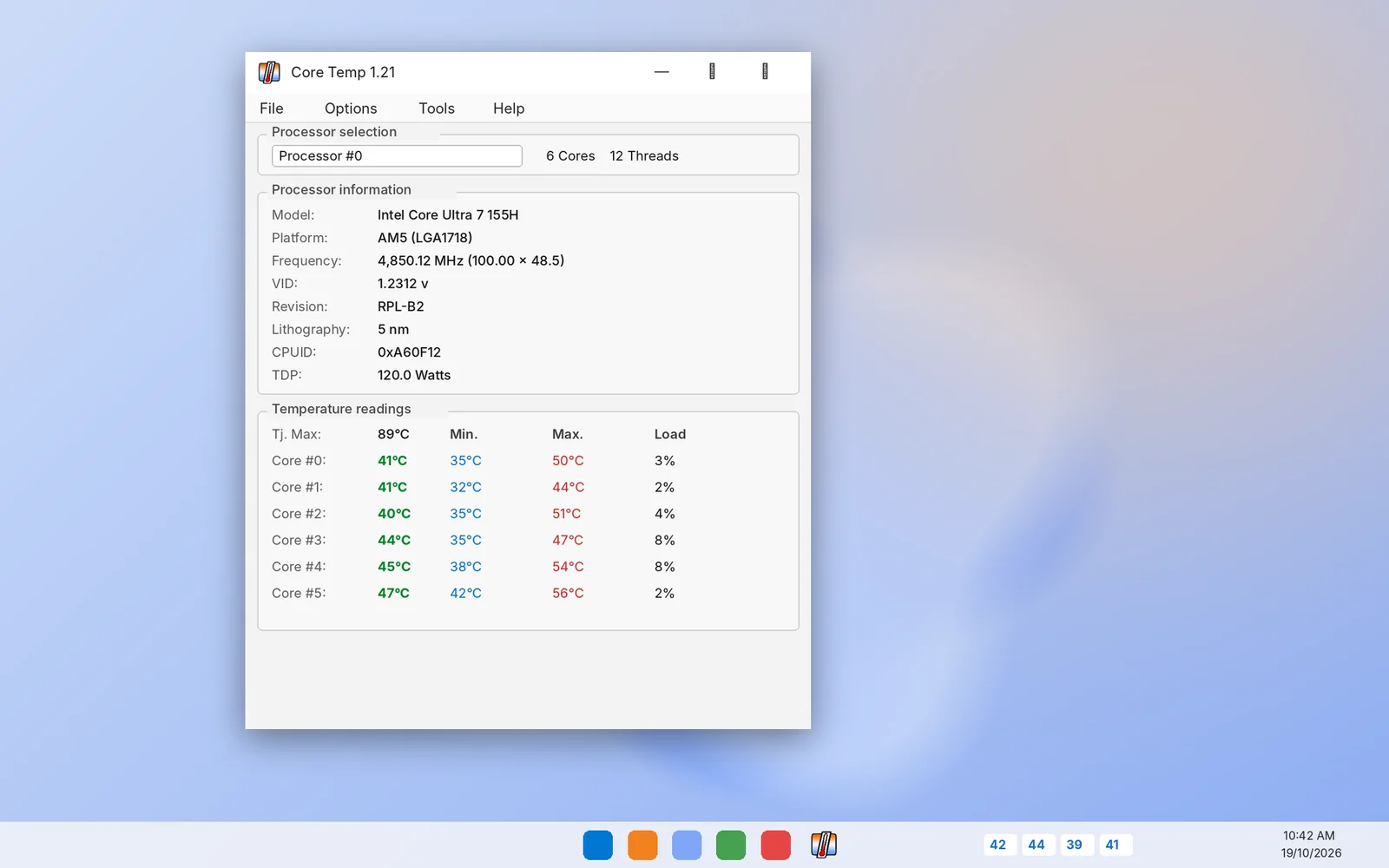
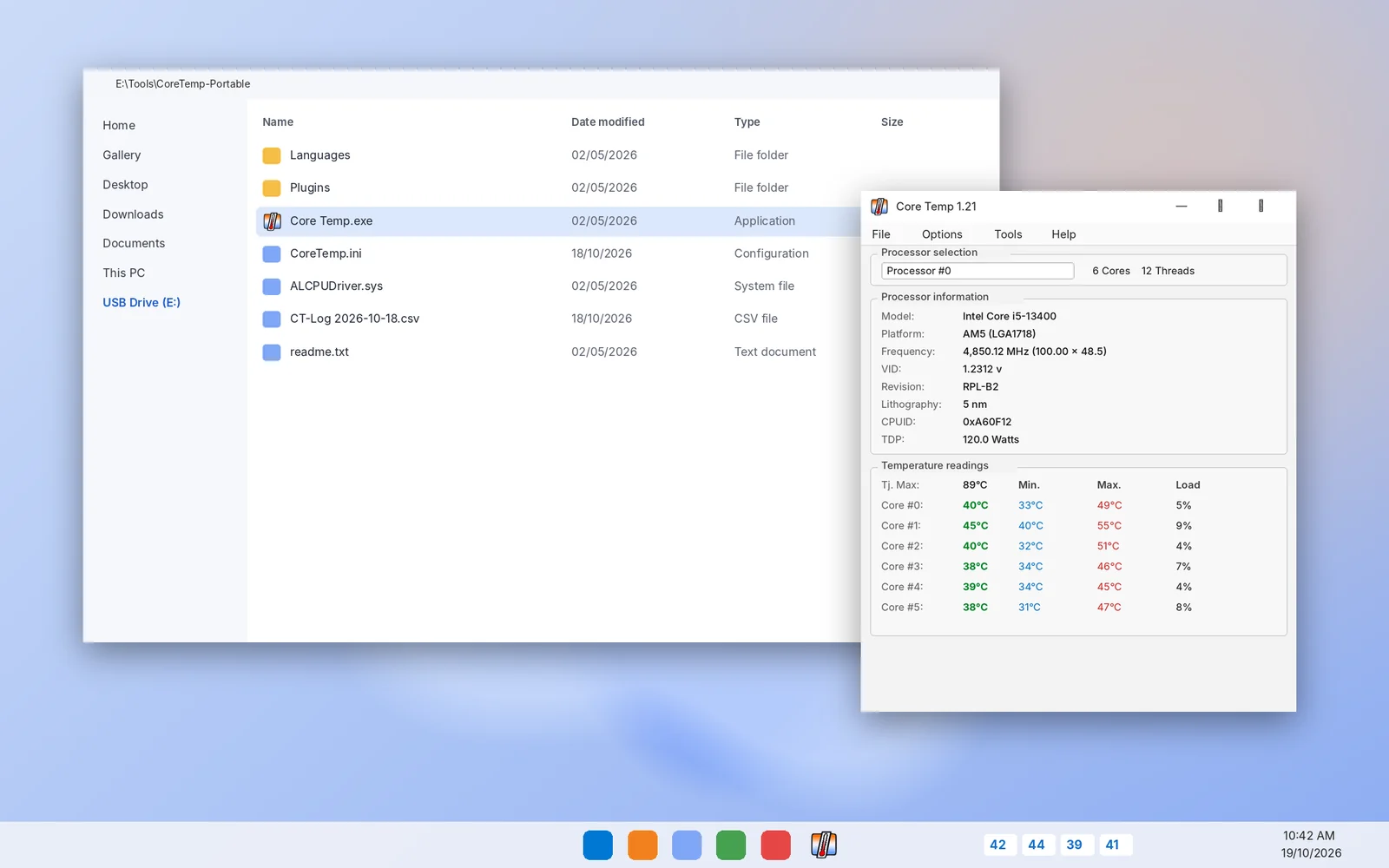
The main window, taskbar icons, logging and overheat protection. Select an image to enlarge it.
Troubleshooting Common Issues
Common problems and how to fix them. Open an item to see the solution.
ErrorNo temperatures or "Not supported" shown
Your CPU may be newer than your Core Temp version, or the driver could not load. Update to the latest version (1.21), right-click Core Temp and choose Run as administrator, and check your antivirus quarantine for the driver file.
ErrorReadings disappear after sleep on Ryzen
This was a known issue fixed in 1.20.1 (May 2026). Install the latest version from the download page and restart once.
Known issueDriver blocked by Memory Integrity
Windows Core Isolation can block some kernel drivers. Keep Core Temp updated; if Windows names the driver as blocked, check the developer's site for a newer build rather than disabling security features.
ErrorTray icons missing on Windows 11
Update to 1.21, which fixes missing tray icons and icon order. Then open Settings › Personalization › Taskbar › Other system tray icons and switch Core Temp on. Also confirm tray icons are enabled in Core Temp's Notification Area settings.
FixTemperatures look too high at idle
Check Load first: background tasks can keep cores busy. Then clean dust, check fan curves and compare with our normal temperature ranges before replacing thermal paste.
FixCore Temp does not start with Windows
Enable "Start Core Temp with Windows" in Settings › General, then make sure it is allowed under Windows Settings › Apps › Startup.
Known issueMin/Max not updating while minimized
Older versions could miss changes while the window was minimized. Version 1.20 fixed this; update if you rely on Max values.
FixAntivirus warns about the installer
Verify the SHA-256 hash first. Generic "PUA" or "bundler" labels usually refer to optional offers in the installer, not to the monitor itself.
Performance Tips
- Raise the refresh interval to 2–3 seconds on older PCs.
- Show only the hottest core in the tray.
- Log every 10 seconds for long sessions to keep files small.
- Disable unused plugins.
Still Stuck?
Read the full troubleshooting guide or our overheating fixes, then contact us with your CPU model and Core Temp version.
Is Core Temp Safe to Use?
Yes, when you download it from the developer and verify the hash. Here is what Core Temp accesses and what it does not.
Core Temp 1.21 mitigates a reported legacy 64-bit driver vulnerability (JVN#23328936), so updating is recommended. Its SHA-256 hash is recorded in the public winget manifest on GitHub, so you can confirm your copy is genuine before running it.
Permissions
Administrator rights to load a small sensor driver. No account is required.
Data Collection
Readings stay on your PC unless you enable logging or a remote-monitoring plugin.
Installer Offers
Setup may present optional third-party software. Decline anything you do not want.
Read the full Core Temp safety review and our privacy policy.
Core Temp Alternatives
Popular Windows hardware monitoring tools compared with Core Temp.
| Software | Price | License | OS Support | Features | Pros | Cons |
|---|---|---|---|---|---|---|
| Core Temp | Free | Freeware | Windows | Per-core temps, tray icons, logging, overheat protection | Light, accurate, protective | CPU only |
| HWiNFO | Free / Pro | Freeware + paid | Windows, DOS | Hundreds of sensors, alerts, logging, reports | Deepest detail | Busy interface |
| HWMonitor | Free / Pro | Freeware + paid | Windows | Temps, voltages, fans, power in one tree | Simple overview | No tray per core |
| LibreHardwareMonitor | Free | MPL 2.0 (open source) | Windows | CPU, GPU, drives, fans, web server | Open source | Fewer polish features |
| Open Hardware Monitor | Free | MPL 2.0 (open source) | Windows | Basic sensors and gadget | Lightweight | Slow development |
| Speccy | Free / Pro | Freeware + paid | Windows | System summary with temperatures | Friendly overview | Limited live data |
Want the details? Read Core Temp vs HWMonitor vs HWiNFO.
Frequently Asked Questions
Answers about downloading, installing, safety, updates, troubleshooting and alternatives.
Download & Setup
Getting, installing and updating Core Temp
Is Core Temp free to download?
Yes. Core Temp is freeware. There is no trial period, no paid tier and no feature limits. The developer accepts optional donations. Be cautious of sites that ask you to pay for it or that wrap the installer in their own download manager; use our download page, which links to the developer's official installer.
Where is the safest place to download Core Temp?
Use a source that lets you verify the file. Our download button fetches the official installer directly from the developer's server, the same file recorded in the public winget manifest for version 1.21 on GitHub along with its SHA-256 hash. After downloading, compare the hash to confirm the file has not been altered.
Does Core Temp work on Windows 11 and Windows 10?
Yes. Core Temp 1.21 runs on Windows 11 and Windows 10, and the developer also lists support for older versions such as Windows 7 and 8.1 plus Windows Server editions. On Windows 11 you may need to allow its tray icons once under Taskbar settings so temperatures stay visible.
Is there a Core Temp portable version?
Yes. The developer offers standalone 32-bit and 64-bit ZIP builds alongside the installer, and Core Temp keeps its settings in a CoreTemp.ini file next to the program, so it works well from a folder or USB stick. Portable mode still needs administrator rights because the sensor driver must load each time.
Can I install Core Temp with winget?
Yes. Open Windows Terminal or PowerShell and run winget install --id ALCPU.CoreTemp -e. Winget downloads the installer listed in the GitHub manifest, checks its SHA-256 hash automatically and installs it. Running winget upgrade later will update Core Temp to newer releases when they appear in the repository.
Is Core Temp available for macOS, Linux or phones?
Core Temp is a Windows program; there is no native macOS or Linux build. Mac and Linux users usually rely on alternatives such as built-in sensor tools. For phones, the developer has offered a companion Android app, Core Temp Monitor, which displays readings from a PC running Core Temp's remote server plugin.
How do I update Core Temp to the latest version?
Download the newest installer and run it over the existing installation; your settings are kept. Winget users can run winget upgrade ALCPU.CoreTemp. Check our download page for the current version number, release date and hash. Updates often add support for new processors, so it is worth staying current on new hardware.
How do I uninstall Core Temp completely?
Open Settings, then Apps, find Core Temp and choose Uninstall. This removes the program and its driver. If you used the portable version, close Core Temp and delete its folder. Optionally remove any leftover CSV logs you saved elsewhere. No account or cloud data needs deleting because Core Temp stores nothing online.
Safety & Support
Security, readings, fixes and alternatives
Is Core Temp safe?
Genuine Core Temp from its developer has a long clean record, and version 1.21 also hardens its legacy 64-bit driver against a reported vulnerability (JVN#23328936), so updating is recommended. It installs a small driver because reading CPU sensors needs low-level access. The installer may show optional third-party offers; decline them if unwanted. Verify the SHA-256 hash to be sure your copy is authentic.
Does Core Temp collect personal data?
No account is needed and the program works offline. Temperatures stay on your PC unless you choose to write logs or enable a remote-monitoring plugin. Logs are plain CSV files that you control. This website itself uses only essential cookies by default; see our privacy and cookie policies for details.
How do I read Core Temp temperatures?
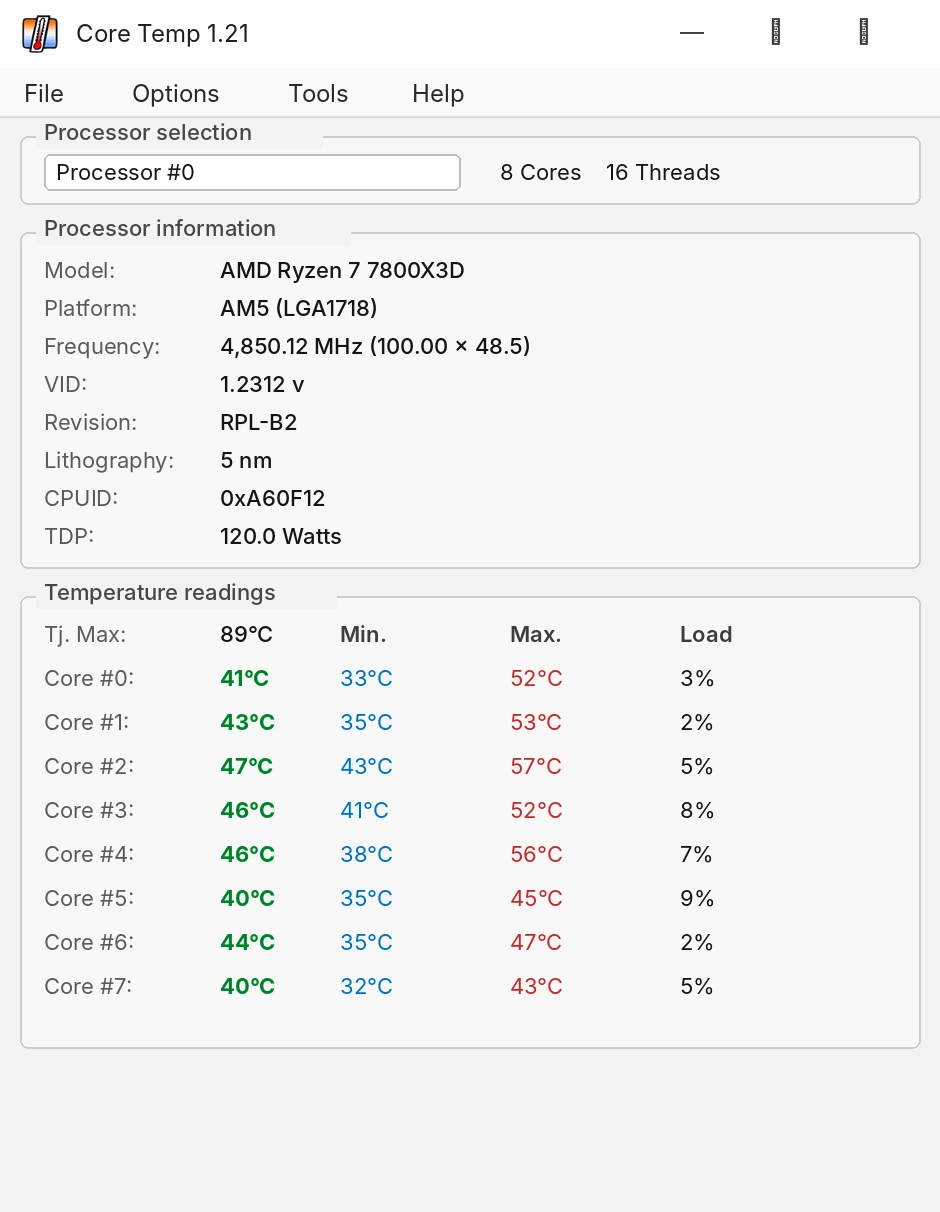
Each row in Temperature Readings is one core. The bold number is the current temperature, Min and Max show the lowest and highest values since launch, and Load shows how busy the core is. Tj. Max is the throttling limit. Our full guide explains each field and the colour codes in detail.
What is a safe CPU temperature in Core Temp?
Most desktop CPUs idle between 30 and 50°C and reach 60 to 80°C while gaming. Laptops run about ten degrees warmer. Short peaks are fine; sustained readings within about 10°C of Tj. Max suggest the cooling has little headroom. Check your exact model, because some modern chips are designed to run hot under load.
Why does Core Temp show different values than other tools?
Monitoring tools may read different sensors. Core Temp shows per-core values, while others may highlight package, motherboard or hotspot temperatures. A difference of a few degrees is normal. Larger gaps usually mean one program does not fully support your processor yet, so update both tools before comparing results again.
Why are no temperatures shown for my CPU?
This usually means the processor is newer than your Core Temp version, the driver was blocked by security software, or the program lacks administrator rights. Update to 1.20.1, run as administrator and check your antivirus quarantine. Version 1.20.1 fixed missing readings on Ryzen systems after a reboot or sleep, and 1.21 adds further processor fixes.
Can Core Temp change fan speeds?
No. Core Temp is a monitoring and protection tool; it does not control fans. Use your motherboard BIOS, the vendor's utility or a dedicated fan-control program for that. Core Temp is still useful alongside them because you can watch temperatures respond as you adjust fan curves.
What are the best Core Temp alternatives?
Popular options include HWiNFO for deep diagnostics, HWMonitor for a quick view of every sensor, and LibreHardwareMonitor as an open-source choice. Core Temp stands out for its small footprint, per-core tray icons and built-in overheat protection. Our comparison table lists each tool's price, licence, platforms and features.
Latest Guides
How-tos, safety checks and comparisons for getting more from Core Temp.
Contact coretemp.org
Questions about this site, a broken link or a correction? Send us a message and we will reply within two business days.
2150 Harbor View Drive, Suite 310
San Diego, CA 92101, USA